
 More
How Far Can an Electric Scooter Travel on a Single Charge?
Introduction
Whether it's a grocery run, a school pickup or a quick trip across town, the last thing you want is for your electric scooter to run out of charge midway. That's why one of the first things riders want to know is how far an electric scooter can travel on a single charge.
That distance, your electric scooter's range, depends on how much energy its battery can store and the conditions you ride in. A scooter has an IDC range and a real-world range, and the two are rarely the same. IDC range, the figure on the spec sheet, comes from a controlled test, while real-world electric scooter range is what you get on the road, shaped by your speed, load and terrain.
Once you understand that gap, the rest falls into place: how battery size shapes the distance you can cover, how much range your daily commute needs, and how often you'll have to plug in.
Key Takeaways
- IDC range is the certified distance a scooter covers on a full charge in a standardised test. Real-world range is what you get in everyday riding conditions like traffic, load and terrain.
- To estimate the range you need, multiply your daily distance by the days you want between charges, then add a 20% buffer.
- You don't need to charge every night. For most daily commutes, charging overnight every few days is enough, and a higher-powered charger cuts down charging time.
What Is the Difference Between IDC Range and Real-World Range?
IDC (Indian Driving Cycle) range is the certified distance a scooter covers on a full charge under standardised test conditions. In the test, the scooter follows a set speed and acceleration pattern in a controlled setting until the battery reaches its discharge limit. Real-world range is the distance you typically get in everyday riding.
Since every scooter is tested on the same cycle at government-authorised centres such as ARAI and ICAT, IDC offers a consistent way to compare electric scooter range across models. However, it does not reflect everyday riding, where several factors can affect range:
- Speed and riding style: Hard acceleration and sustained high speeds use more energy.
- Load: A pillion or heavy bags make the motor work harder, especially uphill.
- Terrain and traffic: Slopes, rough roads and stop-and-go traffic all increase energy use.
- Tyre pressure: Under-inflated tyres add rolling resistance and reduce efficiency.
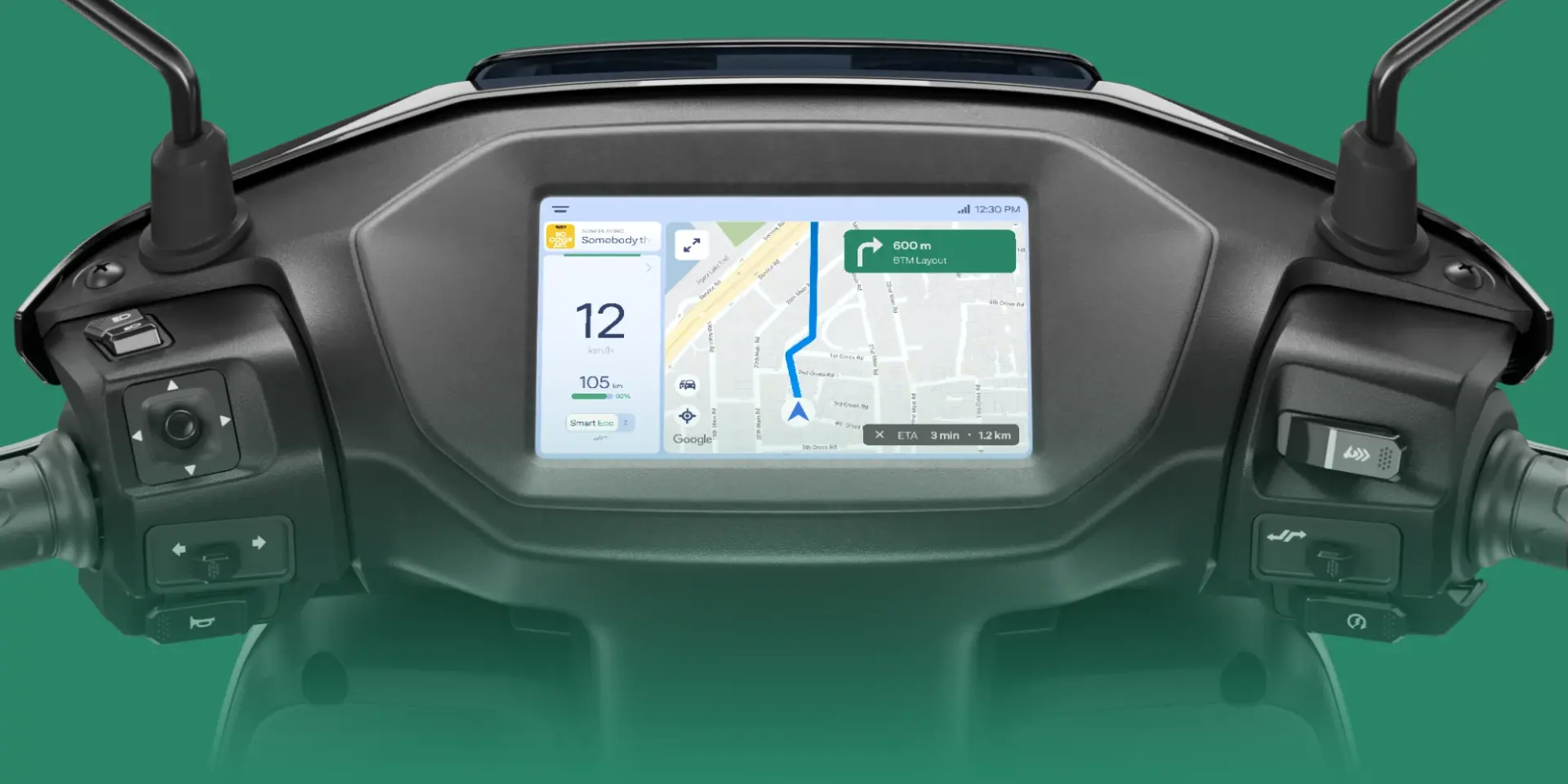
For this reason, Ather developed TrueRange™, an algorithm that shows a real-world range estimate on the scooter's dashboard. This gives you a more realistic idea of your electric scooter's miles per charge, or the kilometres you can expect to cover in day-to-day riding.
How Does Battery Capacity Affect Riding Range?
Battery capacity, measured in kilowatt-hours (kWh), tells you how much energy a battery can store. The higher the capacity, the further a scooter can travel on one charge.
You can estimate range with this simple formula:
Range (km) = Battery capacity (Wh) ÷ Energy used per km (Wh/km)
In normal city riding, an electric scooter can use roughly 30 Wh per km. At that rate, a 3.5 kWh (3,500 Wh) battery would cover about 115 km, while a 2.9 kWh (2,900 Wh) battery would cover about 95 km.
If you ride aggressively or carry extra weight, the scooter uses more energy per km, so you get less range from the same battery.
The Ather 450X, for example, is available in two battery sizes. The 2.9 kWh version has an IDC range of 126 km and a TrueRange of 105 km. With the 3.5 kWh battery, the IDC range rises to 161 km and the TrueRange to 130 km.
A high-range electric scooter with a bigger battery suits longer commutes or riders who prefer to charge less often. For shorter daily trips, a smaller battery may be enough.
How Can You Estimate the Range You Need for Daily Commuting?
To estimate the range you need, multiply your daily riding distance by the number of days you want between charges, then add a 20% buffer. Since most city commutes run 20 to 30 km a day, even a mid-range electric scooter can cover several days of riding on a single charge.
- Work out your daily distance: Add up the kilometres you cover on a typical day, including your commute to work and regular errands such as school drop-offs or grocery runs.
- Decide how often you want to charge: Every night, or once every two or three days.
- Add a buffer: Keep about 20% extra for detours, traffic or a pillion ride.
For example, if you ride 30 km a day and want to charge every three days, you'd need 90 km plus a 20% buffer, which comes to about 110 km of range.
Compare that number against real-world range, not the IDC figure. If your route has slopes or heavy traffic, you often ride with a pillion, or you'd rather charge once a week, a high-range electric scooter is worth considering.
How Often Should You Charge an Electric Scooter?
How often you charge depends on how far you ride each day and your scooter's range. For example, if you ride 30 km a day on a scooter with a real-world range of 130 km, one full charge can last about four days.
Electric scooter charging time depends on battery capacity and the charger you use. Take a look below.
Battery capacity | Charger | Charging time |
2.9 kWh | 450 W home charger | About 5 hours 10 minutes to reach 80% |
3.5 kWh | 900 W home charger | About 3 hours 25 minutes to reach 80% |
Variable per model | Ather Grid fast charger | Up to 30 km of range in 10 minutes |
Overnight home charging is the simplest routine and is gentler on the cells, while fast charging suits top-ups on longer days.
Ather's battery management system uses multiple sensors to balance cells and regulate charge cycles. It also prevents overcharging, so leaving your scooter plugged in overnight is safe. To protect long-term battery health, avoid letting the charge fall below about 5%.
In Conclusion
Choosing the right electric scooter is easier once you know what its range figures mean. The IDC range gives you a fair benchmark for comparing models, while the real-world estimate tells you what to expect on your daily rides. So look past the headline number and match the real-world range to how far you ride and how often you'd like to charge. That way, you'll know how much electric scooter range you really need, and every grocery run or school pickup can start without a second thought about running out of charge.
Visit your nearest Ather Space for a test ride or explore detailed specifications at Ather Energy.

 Anand Kumar5 min read
 Anand Kumar5 min read
 Saikiran T Nuli5 min read
Wish to know more about Ather?
The best things about an Ather can’t be put in words, or captured in images. We’ll take up all your questions, just drop us your number. We’ll call you.
